For the Record: A Transparency Toolkit for Criminal Legal Reporters
The Center for Constitutional Rights, The Center for Just Journalism, and Public Justice
August 3, 2026
Introduction
The American criminal legal system is distributed across thousands of local, state, and federal agencies and departments, each of which collects and produces information about its operations. But just because this information exists doesn’t mean it’s easy to access. The criminal legal system has long relied on outdated data systems and operated with little public or legislative oversight. While modern tools and resources have helped shine a light on the United States’ sprawling and opaque criminal legal system, we’ve begun to lose ground as the federal government, along with some states and localities, have severely limited data collection and reporting.
In recent months, federal agencies have deleted massive amounts of data related to the criminal legal system from government websites, including resources maintained by the many divisions of the U.S. Department of Justice. According to the Council on Criminal Justice, eliminated resources include a database of federal police officer misconduct, data on the gender identity of people in federal prisons, and statistics on racial and ethnic disparities in the youth justice system. Meanwhile, numerous states are considering or have passed legislation that will limit access to information regarding executive and legislative decision-making and make it more difficult to request public records.
This era of declining transparency makes it harder for journalists to do their jobs, from timely and accurate reporting on recent crime and criminal legal trends to serving as a watchdog for powerful government officials and agencies that police, prosecute, and imprison millions of people each year. The Center for Just Journalism, along with transparency experts at the Center for Constitutional Rights and Public Justice, have created this resource to help journalists identify and access the information they need to accurately and thoroughly report on the criminal legal system.
Table of Contents
This project is organized into three sections, each dealing with a distinct method of information-gathering. The first section is focused on finding and interpreting publicly available data from criminal legal agencies. The second section is focused on accessing records from civil and criminal court proceedings. The third section is focused on filing successful public records requests to obtain information from criminal legal and other government agencies.
I. Data: publicly available statistics that are collected and reported by agencies in the criminal legal system, from police departments to parole boards
II. Court Records: documents related to civil litigation and criminal prosecutions, including written briefs, motions, exhibits, court orders, and transcripts
III. Public Records: documents, communications, videos, and other information that are not readily accessible to the general public but can be obtained through open records laws
General Recommendations

-
- Be aware of what is disappearing. Federal agencies have recently deleted significant amounts of criminal legal data from government websites. If information you need has been removed from its original home on the web, check the Internet Archive or other organizations that proactively mirror government data. You may also want to check to see if datasets you rely on are still being updated regularly.
- Save everything you find. Websites move, administrations change, and policies get rewritten. In the aftermath, datasets and reports can disappear. If you come across information that's valuable to your work, download a copy, take a screenshot, or save it on the Internet Archive.
- Look for publicly available information before filing a records request. A significant amount of useful information is available without any formal request (court dockets, agency reports, budget documents, consent decree monitoring reports, sentencing commission data, and on and on). Knowing what's already out there saves time and helps you write more targeted requests for what isn't.
- Explore agency websites. Many police departments and other criminal legal agencies publish at least some data, but it can be hard to find. Check "About Us," "Publications," "Press and Media," "Transparency," or "Statistics" sections of their websites. Annual reports are often good sources of agency data.
- Build relationships before you need them. Court clerks, public records officers, and agency communications staff can significantly speed up your access to information.
Data
1 Most of the data that is publicly available is summary data that the agency has analyzed using more detailed individual-level data. This guide focuses primarily on the summary-level data that agencies commonly publish, but we can also provide support to journalists interested in requesting and analyzing individual-level datasets.
Authors: Laura Bennett and Hannah Riley Fernandez, The Center for Just Journalism
Most agencies in the criminal legal system—from police departments to parole boards—collect and publish some data on their operations.1 While much of this data is accessible online, identifying which agency collects which data can be difficult given the scope and complexity of the criminal legal system.
The Justice Counts project from the Council on State Governments developed a list of common metrics across seven dimensions of the criminal legal system. Of course, not every agency publishes, or even collects, every metric, but this list provides a helpful starting place for journalists wondering which agencies have what data.
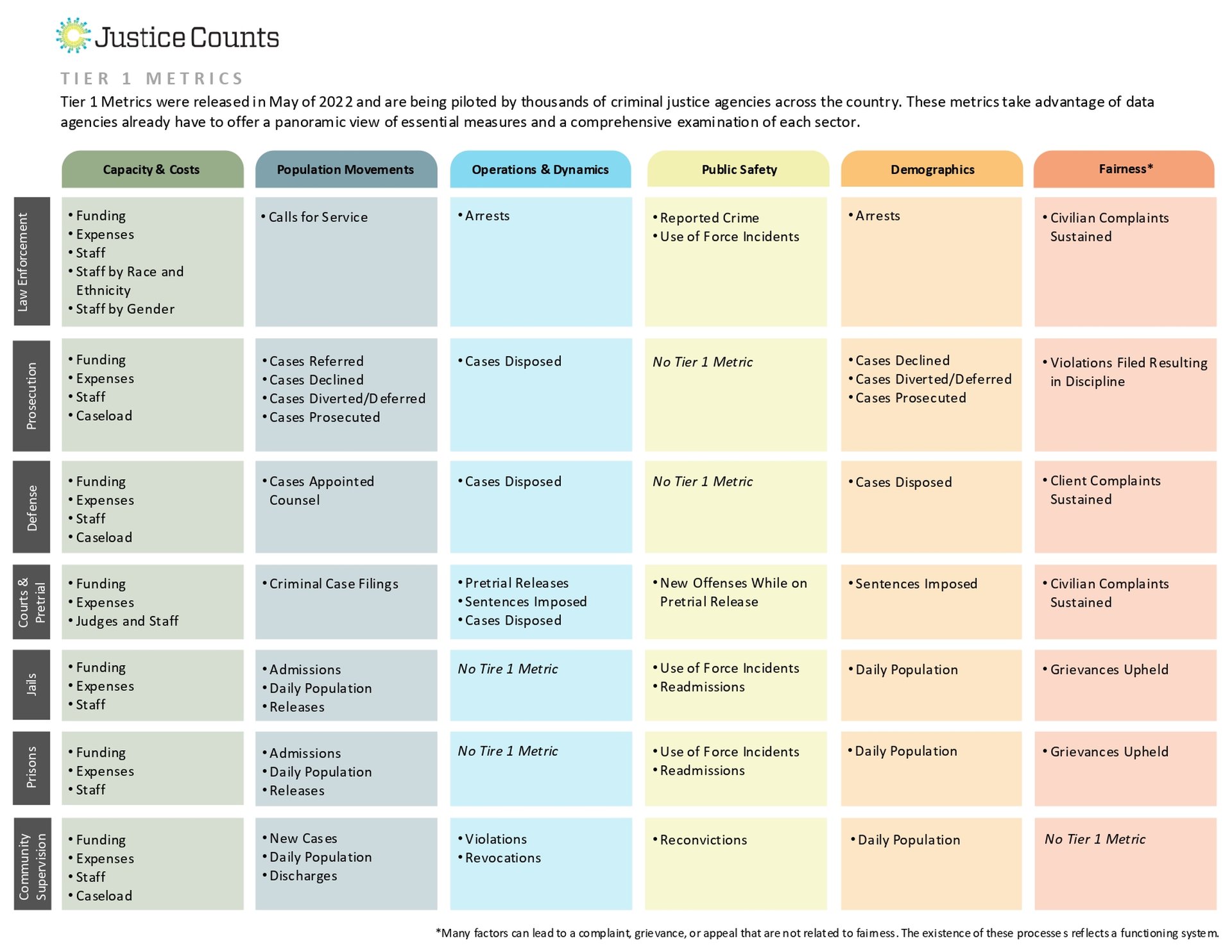
We have organized our recommendations by these same sectors (police, prosecution, public defense, courts, jails, prisons, and community supervision) and added two that do not appear in their metrics (parole boards and youth justice).
Click on a chapter below to find recommendations for accessing this data directly from relevant local, state, and federal agencies, as well as organizations that aggregate and publish data across multiple jurisdictions.
Policing
Almost every community in the United States is policed by multiple overlapping departments including, but not limited to, municipal police, county sheriffs, state highway patrol, K-12 school police, college/university police, capitol police, transit police, tribal police, state Bureaus of Investigation, and the Federal Bureau of Investigation.
Click below to navigate this section.
Common Types of Available Data
- Budget and staffing information
- Calls for service
- Traffic and pedestrian stops
- Reported crimes
- Arrests
- Clearance rate of reported crimes
- Shootings and use of force incidents
- Civilian complaints
- Deaths in custody
How to Access the Data
In small jurisdictions, this data is likely to be limited to crime statistics. In larger jurisdictions, much more detailed information, like calls for service, traffic stops, and use of force incidents, may be available. Some state agencies, like state Bureaus of Investigation or Departments of Public Safety, may also publish data on both local and state police operations. See below for examples from jurisdictions ranging in size from small towns to large cities.
- Annual reports from the Rome (GA) Police Department that include information on civilian complaints, reported crimes, citations, arrests, and more.
- A Data, Statistics, and Reports page from the Durham (NC) Police Department that includes information on staffing levels, reported crime, incident reports, presentations given to the City Council, reports from the Civilian Police Review Board, and more.
- A statistics page from the New York Police Department that includes precinct-level reported crime statistics, traffic violations, personnel data, hate crime statistics, use of force data, stop-question-and-frisk data, arrests at homeless shelters, officer discipline reports, clearance rates, overtime data, and more.
- NYC Open Data has even more detailed, individual-level data from the NYPD on things like calls for service, arrests, and use of force.
Police departments under consent decrees or other forms of government oversight often have appointed independent monitors who have access to and publish data that the department itself might not. Journalists in these jurisdictions should access and download that data while it is still available. Examples include:
- The New York Police Department Monitor regularly reports to the court regarding the NYPD’s progress or lack thereof in achieving compliance with the court’s orders and also publishes special reports with data such as racial disparities in stop-question-and-frisk practices.
- The Consent Decree Monitoring Team for Baltimore City publishes regular reports on the progress of reform in the Baltimore Police Department that include extensive data on their use of force and other misconduct.
- Sometimes the independent monitor’s work needs fact-checking, as Searchlight New Mexico found in their investigation of the Albuquerque Police Department’s consent decree monitor.
There are also several non-governmental organizations that collect and aggregate data on police departments:
- The Police Data Initiative collects and publishes data from more than 120 police agencies across the country. Agencies are able to submit any data they’d like. Available data includes calls for service, reported crime, CCTV locations, use of force, vehicle and pedestrian stops, citizen complaints, juvenile arrests, and more. This data is available in individual-level form.
- The Stanford Open Policing Project collects and publishes data on pedestrian and vehicle stops from dozens of police agencies across the country. This data is available in individual-level form.
- The Council on Criminal Justice Task Force on Policing published national summary statistics on a number of policing metrics, including number of officers, stops, arrests, reported crime, police shootings, and more. This report was published in 2021, and most of the data is from 2015-2019.
- Mapping Police Violence tracks data on killings committed by police officers across the United States. This data is regularly updated. Its sister project, policedata.org, tracks incidents of nonfatal use of force by police officers.
- The Vera Institute of Justice’s Police Data Transparency Index lists the type of data made available by police departments in nearly 100 jurisdictions across the country.
- The National Police Index publishes police employment history data obtained from state police training and certification boards across the U.S. The tool has data from 24 states and plans to add more in the future.
Opportunities for Reporting
Crime statistics are the most widely used data from police departments and typically consist of crimes reported to the police and arrests made by the police. While crime data can be an important measure of public safety, it also has substantial limitations: police don't track certain types of crime (like wage theft and illegal evictions), many people choose not to report crimes to police (like rape), and arrests are a highly biased metric more suited to measuring police activity than underlying criminal behavior. (For more on the uses and limitations of crime data, see this resource from The Center for Just Journalism.)
However, police departments collect other data that can answer important questions about the actions and priorities of the agency, including information about traffic stops, uses of force, and calls for service. Important questions that journalists can answer using police data include:
What are police actually doing with their time and resources? Police officers spend a large portion of their time responding to calls about things other than crime. Analyzing data on calls for service can be a valuable way to understand how your local police department spends its time and money. See, for example, this piece finding that police departments in New Orleans, Montgomery County (MD), and Sacramento spend just 4% of their time responding to violence. Data can help you determine:
- What types of calls do police respond to most frequently?
- What percentage of their time do police spend on non-criminal matters?
- If your community has crisis intervention services, how often are calls diverted to those services? Has the number of police interactions declined as a result of those services?
How often are the police engaging in misconduct or violence? Police data can also be a source of information on civilian complaints, incidents involving use of force or police violence, and deaths of people in police custody. In jurisdictions that do not publish this data (and to supplement the often limited information in those that do), it may be helpful to use independent research from non-governmental sources. For example, Mapping Police Violence tracks data on killings committed by police officers across the United States. For other sources of data on police violence and misconduct, see here. Data can help you determine:
- How often do use of force incidents occur?
- How many people in your community have died in police custody?
- How many complaints have been filed against the police?
- How long, on average, do complaint investigations take? What is the most common outcome for these investigations?
- How much does the city pay in settlements or judgments for misconduct?
Prosecution
Most criminal cases are handled by elected county-level prosecutors (and their staff). These prosecutors—who may be referred to as district attorneys, county attorneys, or state’s attorneys depending on the jurisdiction—are responsible for prosecuting people accused of violating state laws. Federal prosecutors (U.S. Attorneys) are appointed by the president and operate out of 94 federal judicial districts to prosecute people accused of violating federal laws.
Click below to navigate this section.
Common Types of Available Data
- Budget and staffing information
- Case filings
- Dismissal rates
- Pretrial release recommendations
- Plea bargain rates
- Conviction rates
- Sentencing recommendations
- Diversion program outcomes
How to Access the Data
Data from prosecutors’ offices is among the most difficult in the criminal legal system to come by. Many offices don’t publish any data at all. However, some prosecutors—especially those elected on platforms of reform—have begun to publish more data about their operations.
- The Philadelphia District Attorney’s Office maintains a wide-ranging public data dashboard with information about conviction rates, years of incarceration imposed, exonerations, and much more.
- The group behind Prosecutorial Performance Indicators has worked with prosecutors’ offices in California, Colorado, Florida, Illinois, Louisiana, Maryland, New York, Oregon, South Carolina, and Wisconsin to improve their data collection and sharing practices. Data dashboards from several of the offices with which they work are available online. Prominent examples include Florida’s Fourth Judicial Circuit (which includes Jacksonville), Santa Clara County (California), and several judicial districts in Colorado.
- The Bureau of Justice Statistics periodically publishes the Prosecutors in State Courts series. Reports from this series cover the number of attorneys employed in prosecutor offices, operating expenditures, case outcomes, and more. The data is based on a national survey and is not broken down by state or region. The most recent available data is from 2020.
Opportunities for Reporting
Prosecutors have tremendous discretion in the criminal legal system, choosing what charges to file, which cases to prosecute, and often which sentences people receive. However, their operations receive far less media attention than police departments, jails, or prisons. Important questions that journalists can answer using prosecution data include:
How do plea bargains impact sentencing outcomes? Another opaque and poorly understood aspect of the criminal legal system is plea bargaining. The vast majority of criminal cases never go to trial. Roughly 5% of state felony prosecutions end in trial, and the percentage is even lower for federal cases. Most convictions are the result of plea deals in which prosecutors effectively act as judge and jury by offering reduced charges or sentences that are more favorable than the original charges. Data can help you determine:
- How often are charges downgraded prior to plea deals? Could this be evidence of “upcharging” (filing more serious charges than are appropriate in order to secure a plea bargain)?
- Are people jailed before trial more likely to take a plea deal than people who aren’t?
- Are sentences longer for people who go to trial compared to people who take a plea deal for the same offense (i.e. the trial penalty)?
How often are prosecutors using diversion programs? Most prosecutors have access to diversion options that allow defendants to avoid convictions and many of the harmful collateral consequences of the criminal legal system if they complete certain programs or other requirements such as community service. To learn more about the diversion programs in your jurisdiction, see this resource from the National District Attorneys Association (NDAA) and the Urban Institute. Data can help you determine:
- How often are diversion programs in your community being utilized?
- Are there racial or socioeconomic disparities in who receives diversion compared to prosecution?
- What percentage of people are removed from diversion for “technical violations” or inability to pay program fees?
Public Defense
The structure of public defense systems varies widely across states and localities, from elected offices to independent lawyers appointed by judges, though the majority are appointed at the county or state level. See this project from the Sixth Amendment Center to learn more about how public defense works in each state.
Click below to navigate this section.
Common Types of Available Data
- Caseload numbers
- Budget and staffing information
- Case outcomes
- Fee structures
- Contract oversight information
How to Access the Data
Data on public defense is more likely to be available in places with statewide administration and oversight. State offices, councils, or commissions on public defense are a good place to start your search.
- The Maryland Office of the Public Defender publishes annual reports with data on the number of clients represented, the average hours per case, and the attorneys needed to provide adequate counsel. The reports also include information on the number of children charged as adults, cases that result in termination of parental rights, and other data on the impact of the court system on families.
- The Oregon Public Defense Commission maintains a data dashboard with regularly updated data on the number of appointed cases, case status, and other key information organized by county and court division.
- In jurisdictions that leave public defense entirely up to local authorities, data may be difficult or impossible to come by, but interviews with local defense attorneys can be a good alternative.
- At the national level, the Bureau of Justice Statistics is creating a new data set that will directly survey public defenders. It will include data on public defender caseloads, defendant and attorney demographics, and case outcomes. The data is still in the collection process and has not yet been published.
Opportunities for Reporting
Public defenders are constitutionally required to provide effective representation, but in many jurisdictions they are underfunded, understaffed, and carrying impossible caseloads. While prosecutors and police departments often have communications teams and data dashboards, information about public defense is sparse (an absence that is itself a story). Caseloads, budgets, wait times for assignment, and fee schedules can reveal whether the right to counsel guaranteed under the Sixth Amendment exists only on paper.
How long do people wait to meet their lawyers and what happens while they wait? In some places, defendants can be detained pretrial before even meeting an attorney. Delays in assigning counsel can have cascading consequences, influencing the likelihood of pretrial release, plea bargain rates, and sentence lengths. Data can help you determine:
- At what point in the criminal process is defense counsel assigned?
- How many people are detained pretrial before meeting a lawyer?
- How long do people typically wait before meeting with their attorney?
- Does pre-appointment detention correlate with higher plea rates or longer sentences?
- Are there racial or gender disparities in when representation is provided?
Are people paying for their “free” lawyer? Although the right to counsel is supposed to be free, many states charge defendants for exercising it. People can be billed application fees to receive a public defender, charged hourly fees for representation, or invoiced after their case concludes—even if they are acquitted. In some jurisdictions, unpaid legal fee debt is sent to collections or converted into civil judgments. In extreme cases, failure to pay can lead to warrants or credit damage, trapping people in cycles of poverty and criminalization. Data can help you determine:
- Are defendants being charged to apply for or be assigned a public defender? How much are those fees?
- What happens when someone cannot pay? Are fees sent to collections, converted to civil judgments, or used to justify probation extensions or warrants?
- How much revenue does the jurisdiction expect to generate from these fees each year? How much actually gets collected (it’s usually very little) and at what administrative cost? (Answering these questions would require consulting local budget documents.)
Courts
Most criminal cases in the United States are handled in state courts, with structures that vary significantly from state to state. In some jurisdictions, low-level crimes like traffic violations and misdemeanors are handled in municipal courts. Meanwhile, federal courts oversee federal criminal charges and appeals from state courts. You can learn more about each state’s court structure in this resource from the Court Statistics Project.
Click below to navigate this section.
Common Types of Available Data
- Court calendars
- Case filings
- Bail and pretrial detention information
- Case outcomes (convictions, acquittals, dismissals)
- Case processing times
- Sentencing data
How to Access the Data
The most likely place to find statistics on state court proceedings is with your state’s Administrative Office of the Courts (which might be called the Office of Court Administration or another similar name). These agencies are often tasked with collecting and aggregating data for public use. Examples include:
- The Judicial Branch of California publishes data on case filings and dispositions by county and case type, judicial and court employees, and more.
- Maryland’s Administrative Office of the Courts publishes annual reports, a data dashboard, and other resources with information on case filings and terminations, average disposition times, protective orders issued, and more.
- The Texas Judicial Branch publishes annual statistical reports with detailed information on case filings and dispositions with breakdowns by offense type (e.g. drug offenses or auto theft) as well as by court level including civil, family, criminal and juvenile court.
In addition to information maintained by the courts themselves, many states have a sentencing commission that is either managed by the courts or was created as an independent agency responsible for collecting and analyzing data, making recommendations on sentencing policy, and training judges and other practitioners on changes in the law. For a primer on the role of sentencing commissions, see this resource from the Robina Institute. Journalists in jurisdictions with a sentencing commission can find a wealth of data and information on court outcomes from these commissions. For example:
- The North Carolina Sentencing and Policy Advisory Commission publishes annual reports with data on sentencing decisions, prison population projections, evaluations of policy changes, recidivism rates, and other key information on court outcomes.
- At the federal level, the U.S. Sentencing Commission—a bipartisan, independent agency—collects, analyzes, and publishes data on federal sentencing practices. In addition to their regular reports, they maintain an interactive data tool with information organized by court circuit, state and judicial districts.
There are also some non-governmental organizations that collect and publish data about courts.
- Scrutinize publishes data on judicial decision-making in New York State, including profiles of individual judges across the state and reports that summarize data on bail setting, discovery decisions, and court transparency.
- The State Law Research Initiative publishes detailed information on state supreme court justices, including demographics, professional backgrounds, and political affiliations.
In addition to the information covered here, the next section of this toolkit provides more detail on accessing court records from both civil and criminal proceedings.
Opportunities for Reporting
Court data can help journalists and their audiences understand how cases move through the system, how often pretrial detention is being imposed, what the sentencing outcomes are for defendants in one jurisdiction versus another, and even how individual judges handle cases in their court.
Important questions that journalists can answer using court data include:
How often and for what reasons are people held before trial? Court data can reveal important information about the bail amounts that are being set by the court and how often judges order people to be detained before trial without bail. Data can help you determine:
- What are the bail amounts set by judges in different case types?
- How often do judges deny bond or bail in eligible cases?
- Are there racial or gender disparities in who is released pretrial?
- How long does it take for cases to be resolved?
How many people are receiving convictions for misdemeanor and felony offenses? The vast majority of convictions that are handed down by the courts each year are for misdemeanor rather than felony offenses. Court data can reveal how many people are receiving convictions in your community each year and for what offenses. Data can help you determine:
- How many convictions each year are for violations? Misdemeanors? Felonies?
- How often are people convicted of crimes that do not carry a jail or prison sentence?
What are the sentencing outcomes in your jurisdiction? Court data can be an important source of information on the sentences that people are receiving in your community. Journalists can use this information to explore how sentencing outcomes vary by judge or county across your state, including whether there are judges handing down sentences that are much harsher than their peers. Data can help you determine:
- What is the average sentence length for different offenses?
- Are there sentencing disparities by race, gender, or pretrial status?
- What share of people are receiving probation or another alternative to incarceration?
Jails
Jails hold people accused of crimes who cannot afford bail or were ordered to be held without bail before trial. Many also incarcerate people convicted of misdemeanors (usually sentenced to less than one year), and some rent space to state or federal prison systems as well as Immigration and Customs Enforcement (ICE).
Jails are typically administered at the county level, run by locally elected sheriffs, and funded through a combination of local taxes and federal and state transfers. Some jurisdictions also have city jails, which are typically run by police departments and hold people before their pretrial detention hearings.
Click below to navigate this section.
Common Types of Available Data
- Budget and staffing data
- Daily population counts
- Admission and release numbers
- Demographics of jail population
- Length of stay information
- Deaths in custody
How to Access the Data
Because jails are run at the local level and there is no central, statewide agency responsible for their oversight, accessing data can be challenging. However, local sheriff’s offices and other jail administrators sometimes publish data on the jail population including numbers of people admitted and released, admission type (pretrial vs. sentenced), and length of stay information. Examples include:
- The Los Angeles County Sheriff’s Department publishes a wide range of data on the Transparency page of its website, including data on the jail population. These reports have information about the average daily population, arrests and bookings by offense class (misdemeanor vs. felony), admission type (sentenced vs. unsentenced), and other key information broken down by race, gender, and other demographics.
- The Cook County (IL) Sheriff’s Office publishes daily reports on the jail population, including demographic, facility, and custody information.
- Harris County (TX) maintains a dashboard with information on its jail population, including demographics, charge types, pretrial status, bail amounts, and trends over time.
- The Larimer County (CO) Sheriff’s Office publishes data on its jail population, including capacity, demographics, sentence type, length of stay, and treatment provision.
- New York is unique in that a state agency—the Division of Criminal Justice Services—publishes a monthly report on the state’s jail population broken down by county.
There are also several sources of national data that can be helpful for understanding trends in jail incarceration and pretrial detention:
- The Bureau of Justice Statistics (BJS) collects and publishes data on the jail population as part of its annual Jail Inmates Series.
- In addition to its annual Whole Pie report with data on how many people are incarcerated in the United States, the Prison Policy Initiative analyzes data from BJS and publishes analyses of the national jail population. Their reports also provide additional research and context on the impact of pretrial detention and jail conditions.
- The Vera Institute of Justice’s Incarceration Trends project offers an interactive tool with county-level jail data dating back to 1970, including jail population counts, admission rates, incarceration rates by demographics, and racial disparities. Data can be examined for individual counties or compared across jurisdictions.
- The Jail Data Initiative scrapes daily county jail rosters from over 1,300 counties and provides the daily jail population, admissions and releases, and length of stay information from its roster of sources.
Opportunities for Reporting
Local jails are the entry point for most people who experience incarceration, holding millions of people each year, many of whom have not been convicted of a crime. Yet data on who is admitted, why they are held, and for how long is often limited or difficult to access. By examining jail admissions, pretrial detention practices, and conditions of confinement, journalists can reveal more about a highly impactful but poorly understood aspect of the criminal legal system.
How many people go to jail in your community each year? Millions of people spend time in local jails every year, far more than the number of people who cycle through U.S. prisons annually. The scale of jail incarceration is best understood by looking at annual admissions rather than daily populations, since many people stay only a few days or weeks. For example, in 2022—the most recent year with publicly available data—the average daily population in jails was 652,500, but there were 7.3 million admissions over the course of the year (down from a high of 11.7 million in 2013). Data can help you determine:
- How many people are admitted to jail in your community each year?
- What percentage of admissions involve low-level offenses, unpaid fines or fees, or probation or parole violations?
- How do annual admissions compare to the average daily jail population? Does your jail function like a revolving door or a long-term detention site?
- If individual-level data is available: How many people are booked multiple times in a single year? What is driving those patterns (housing insecurity, mental health needs, or substance use)?
Who is being held pretrial and why can’t they leave? Pretrial detention is one of the main drivers of jail incarceration. Many people remain in custody because they cannot afford bail. Data can help you determine:
- What share of the jail population has not been convicted of a crime?
- What are the most common charges among people held pretrial?
- How many people are detained only because they cannot pay bail?
- Are there racial or socioeconomic disparities in pretrial detention?
What are the human costs of short-term detention? Even brief stays in jail can cause lasting harm. People can lose housing, jobs, custody of their children, and access to medication or medical care. Overcrowding and poor conditions create additional risks, from violence and neglect to preventable deaths. Some jails also collaborate with federal immigration enforcement, deepening the reach of detention far beyond the local level. Data can help you determine:
- Is the jail overcrowded? How does the current population compare to capacity?
- How does the jail manage overcrowding? Are people held out of county or placed in isolation?
- How many people have died in custody in recent years? What were the reported causes of death, and are there patterns by race, age, length of stay, or medical need?
- Does the jail cooperate with ICE through formal agreements (287g) or detainer requests?
- How many people are being transferred to ICE after they resolve their charges?
Prisons
State prisons typically incarcerate people convicted of state crimes, while federal prisons incarcerate those convicted of federal crimes. Although the federal prison system is the largest in the country, the vast majority of people in prison are incarcerated at the state level. According to a 2026 report from the Prison Policy Initiative, there are 201,000 people in federal prison and 1,098,000 people in state prison.
Click below to navigate this section.
Common Types of Available Data
- Daily population counts
- Admission and release numbers
- Demographics of prison population
- Sentence lengths and time served
- Parole grant rates
- Deaths in custody
- Budget and staffing information
How to Access the Data
Most state Departments of Corrections publish data on the prison population. Many departments publish either daily or weekly counts that provide a real-time snapshot of the population, and almost all publish annual reports with data on admissions, releases, and the makeup of the prison population at the end of the fiscal or calendar year. A few states also release prison population projections that forecast how the prison population will change in the future. Examples of these different sources of information include:
- The Mississippi Department of Corrections publishes daily reports on the prison population with the number of people imprisoned in each facility.
- The Florida Department of Corrections publishes annual reports with data on the admissions, releases, and an annual snapshot of the prison population broken down by race, gender, and age.
- The California Department of Corrections and Rehabilitation (CDCR) publishes a wide range of weekly and annual data, including information on program participation. CDCR also publishes twice-annual prison population projections to help policymakers and journalists understand drivers of and changes in the prison population.
- At the federal level, the Bureau of Prisons publishes statistics on the federal prison population.
- The Bureau of Justice Statistics publishes annual reports with data on state and federal prison populations including breakdowns by offense types (drug, property, violent), demographics (race and gender), prison overcrowding, admissions, and releases. However, these reports often come out anywhere from 12 to 24 months after the time of the data collection and are therefore more helpful for long-term analyses of the national prison population and comparisons between states that might otherwise be difficult to make.
There are also a wide range of resources from non-governmental organizations. Examples:
- The Prison Policy Initiative releases a project called Mass Incarceration: The Whole Pie each year, summarizing data from multiple sources to provide a comprehensive overview of incarceration in the United States.
- The Sentencing Project maintains a data tool called U.S. Criminal Justice Data with detailed state-by-state information on imprisonment rates, racial disparities, youth detention, and felony disenfranchisement. Their reports also provide valuable research on trends in life sentences and analysis of criminal justice policy changes each legislative cycle.
- Worth Rises compiled a database of corporations that do business with public and private prison and detention systems.
Opportunities for Reporting
Most state Departments of Corrections publish data that can help journalists shed light on trends in the size and makeup of the prison population, what happens to people while they’re incarcerated, and when and why they return home from prison. This information can illuminate how sentencing laws, parole policies, and prison conditions impact your community.
Who is being sentenced to prison and for what? Prison data is often a rich source of information on admissions, including the number of people sent to prison each year, the types of offenses they were convicted of, and whether they are being admitted for a new crime or a technical violation of supervision. Examining this data can reveal how sentencing and supervision policies drive incarceration, especially for nonviolent and lower-level offenses. Data can help you determine:
- What share of people are being admitted to prison for nonviolent drug and property offenses?
- What share of people are being admitted for violating supervision conditions rather than committing a new crime?
- Are admissions to prison rising or falling overall and what’s driving those changes?
How long are people spending in prison and who is serving the longest sentences? The number of people in prison who have already served long sentences has been growing for years. While it can be difficult to calculate the average time served across all incarcerated people, most departments of corrections publish release data that offers a snapshot of sentence length and release mechanisms. Looking at this data can highlight trends in sentencing, parole, and the treatment of older incarcerated people. Data can help you determine:
- How long, on average, are people incarcerated before their release?
- What proportion of people are serving sentences for offenses committed when they were children or young adults?
- By what mechanism are people being released—discretionary parole, earned release, completion of sentence, or another process?
- Are there racial or other demographic disparities in time served or release decisions?
How, if at all, are people in prison preparing people for reentry? Departments of Corrections are mandated to offer rehabilitation programs (education, job training, and behavioral health treatment) that, at least on paper, prepare people to return to their communities. In states with “earned time” policies, participation in these programs can determine when someone goes home. Understanding who gets access to programming, and who doesn’t, can expose major inequities within the system. Data can help you determine:
- What types of programs are available in your state’s prisons?
- How many people participate in these programs, and how does participation vary by facility or region?
- Are there waiting lists, and do delays in access to programming extend people’s incarceration?
How is your state’s prison population changing and what’s driving those trends? In many states, sentencing commissions or corrections agencies publish population projections and spending forecasts that reflect the impact of new laws or policies. These projections can reveal whether reforms are reducing incarceration or whether new restrictions are quietly expanding it. Data can help you determine:
- What is the projected prison population for your state over the next five or ten years?
- Is the population expected to grow and at what cost to taxpayers?
- What policy or sentencing changes are driving these trends?
- How do these projections compare to recent historical trends in your state? To other states in the region?
What are conditions like inside your state’s prisons? Overcrowding and understaffing are chronic issues in many prison systems, contributing to violence, medical neglect, and preventable deaths. In recent years, staff shortages have worsened conditions and left facilities unprepared for crises such as extreme heat or natural disasters. By combining data with lived experience and on-the-ground reporting, journalists can bring public attention to what happens behind prison walls. Data can help you determine:
- Is prison overcrowding a problem in your state? How does the current population compare to official capacity?
- What are the required and actual staffing levels for your state’s prison system? How have they changed in recent years?
- How many people have died in state custody in recent years, and what were the causes?
Community Supervision (Probation and Parole)
Probation and parole are both forms of "community supervision" in which people serve all or part of their sentence in the community under the supervision of a probation or parole officer. The conditions of community supervision can include everything from in-person meetings and work requirements to electronic monitoring and curfews.
Probation sentences are typically court-ordered in lieu of a prison sentence while parole or post-release supervision typically follows a period of incarceration. In both cases, the supervision term can be “revoked” if the person is found to have violated the conditions of supervision. In the case of probation, revocations typically result in the person serving the prison sentence that the judge initially allowed them to avoid. In the case of parole or post-release supervision, revocations typically result in the person serving the remainder of their original prison term.
In some states such as Arizona, California, and Texas, probation is managed by the judiciary and run at the county rather than the state level. In other states such as North Carolina and Louisiana, probation is managed by the executive branch through the Department of Corrections or a joint Department of Corrections and Community Supervision. In other states such as Georgia, another executive branch agency manages probation. Typically, the court system holds revocation hearings at the request of probation officers and determines when to revoke probation.
Parole is typically managed within the Department of Corrections or an independent parole board, which also makes revocation decisions at the request of parole officers. Numerous states abolished parole in the 1980s and 1990s, but in these states people can still be released with time remaining on their sentence due to “good time” or “earned time” credits and serve a period of post-release supervision.
Click below to navigate this section.
Common Types of Available Data
- Number of people on supervision (probation, parole or post-release supervision)
- Supervision terms (length of supervision)
- Supervision conditions and requirements
- Violations of supervision
- Revocations for new crimes
- Revocations for technical violations of supervision
- Demographic information
- Budget and staffing information
How to Access the Data
In states where community supervision is managed by the executive branch, the Department of Corrections (or your state’s equivalent agency) will publish data on the supervision population in addition to data on the prison population. In places with county-run or judicial probation, the judiciary or county government is more likely to publish the relevant data. Examples include:
- The Georgia Department of Community Supervision maintains a data dashboard with key information on the supervision population including supervision type (probation vs. parole), demographics such as age, gender, and race, and offense type going back to 2017.
- The North Carolina Department of Adult Corrections publishes annual statistical reports with key information on both the prison and supervision populations.
- The Arizona Judicial Branch manages probation through its Adult Probation Services Division and publishes monthly and annual reports with data on the probation population including cost savings achieved through reductions in revocations.
- The Bureau of Justice Statistics publishes an annual report on Probation and Parole in the United States with state-level data on the number of adults on probation and parole, entries and exits from supervision, characteristics of those under supervision, and supervision outcomes including successful completions and revocations. These reports provide the most comprehensive national overview of community supervision populations, but the data is typically released 1-2 years after collection.
Some non-governmental organizations also collect and publish data on community supervision.
- The Prison Policy Initiative’s Mass Incarceration: The Whole Pie project includes information about the community supervision population.
- The Council of State Governments Justice Center has also published reports with state-by-state data on the share of prison admissions that are the result of revocations from community supervision.
Opportunities for Reporting
While probation and parole are often described as alternatives to incarceration, they are also major drivers of it. In most states, revocations for rule violations or new arrests account for a large share of prison admissions. People can end up behind bars not for committing new crimes but for missing curfews, failing drug tests, or being unable to pay supervision fees. By examining supervision data and conditions, journalists can explore whether these systems are setting people up for success or ensuring they fail.
How often are people incarcerated for violating the rules of probation or parole? Most supervision agencies track how many people have their supervision revoked and the reasons for those revocations. Examining this data can show how much probation and parole contribute to the size of the state’s prison population and how "technical" violations like missing a meeting or failing to pay fees contribute to reincarceration. Data can help you determine:
- What share of supervision terms end in incarceration?
- How many revocations result from new arrests compared to technical violations such as failing a drug test or missing a check-in?
- What are the most common technical violations leading to revocation in your jurisdiction?
- How much of the state’s total prison population is there because of supervision revocations?
- What is the financial cost to the state and to individuals of reincarcerating people for rule violations?
What are the conditions of supervision and are they achievable? Supervision data can sometimes reveal which conditions people are required to follow, and interviews or court records can fill in the gaps. These conditions often go far beyond “staying out of trouble,” including mandatory fees, employment requirements, curfews, and drug testing. In many cases, the number and rigidity of conditions make compliance nearly impossible. Data can help you determine:
- What conditions are most commonly imposed on people under probation or parole?
- Are there conditions such as fines, restitution, or mandatory program fees that effectively criminalize poverty?
- Who profits from supervision fees, mandated treatment programs, or electronic monitoring contracts? (Answering these questions would require consulting local budget documents.)
Parole Boards
More than 30 states have some form of a parole process that allows incarcerated people who have served their minimum sentence to go before a parole board whose members make discretionary release decisions on a case-by-case basis. Even in those states that abolished parole in the 1980s and 1990s, there are many people in prison who were sentenced for parole-eligible offenses before the law changed that can still be considered for release. You can read more about each state’s parole system in this report from the Prison Policy Initiative and more recent developments in parole law in this primer from Campaign Zero.
Parole boards were not covered by the Justice Counts project but serve an important function in the criminal legal system that is not well understood and is often misrepresented in reporting. For that reason, we have included a section specific to data on parole decision-making.
Click below to navigate this section.
Common Types of Available Data
- Time served before parole consideration
- Parole grant rates
- Reasons for denials
- Number of people in prison past their parole eligibility date
- Hearing types (in-person versus virtual)
How to Access the Data
Parole board data availability varies significantly by state. Some states publish regular reports while others provide little to no public information about parole decisions. Below are examples from states that publish much of the data that is needed to answer the questions posed above:
- Annual reports from the Texas Board of Pardons and Paroles include parole grants by offense, approval rates for individual commissioners and Board members, and annual trends.
- Nevada publishes quarterly and annual reports with data on parole hearings and the number of people granted and denied parole, parole violation hearings and the number of people reinstated and revoked, as well as other release decisions related to early discharge.
There are also several non-governmental organizations that collect and aggregate data on parole including:
- The Prison Policy Initiative has published a primer on state parole systems with helpful information on the states with discretionary parole including how parole hearings work and decisions are made, as well as data on parole grant rates and other key performance indicators.
- The Council on State Governments has published data on the number and share of people in prison past their parole eligibility date for each of the states with some form of parole.
- The Robina Institute has published a report examining the legal and statutory framework of state and federal parole release decision-making processes.
Opportunities for Reporting
Parole is one of the most significant mechanisms for reducing prison populations, yet it often operates with limited transparency. Many states publish data on the number of people considered for parole and the parole grant rate, but few explain how decisions are made or what factors influence approval or denial. Pairing data with interviews with parole board members and impacted people can help journalists reveal how parole boards exercise discretion, how release decisions affect overcrowding, and how policies shape who gets to return home and who remains behind bars.
How often is the parole board granting release? The parole grant rate is the key measure of how a state’s parole board uses its authority. It is usually calculated as the number of people granted parole divided by the number considered for release. This figure can often be broken down by offense type, race, gender, or age. Tracking changes over time can show whether parole is being used as a meaningful release mechanism or whether approvals are becoming more restrictive. Data can help you determine:
- What is the current parole grant rate in your state, and how has it changed over time?
- Are there racial, gender, or geographic disparities in parole approvals?
- Are certain offense categories denied parole at consistently higher rates?
- What reasons does the parole board most frequently cite for denial?
- How do parole grant rates vary by board member or by panel composition? (Some states publish data by individual commissioner.)
- How many people are approved on first review compared to those approved after multiple hearings?
How are parole decisions impacting your state’s prison population? In many states, a significant portion of people in prison are eligible for parole but remain incarcerated. Journalists can help shed light on why this is the case, which is particularly important in states with serious prison overcrowding issues. Data can help you determine:
- What share of the prison population is currently eligible for parole but has not yet been reviewed? What share of these people have not yet had a parole hearing? What share have been denied release?
- How much of their sentence are people serving, on average, before being considered for parole?
- How many people have been denied parole multiple times after reaching eligibility?
- What is the average number of hearings before approval for those eventually released?
- How would increased parole grant rates impact prison overcrowding issues?
Youth Justice
Children who are charged with crimes are often subject to the same systems and institutions as adults—police, courts, jail, and prisons. But there are often separate agencies that deal with kids, particularly if they are not being charged as adults. Cases are typically heard in juvenile or family court; cases are focused on “delinquency” rather than “guilt”; and most incarcerated children are housed in youth detention facilities, although thousands are also held in adult jails and prisons across the country. The U.S. Department of Justice published a brief explainer on the youth justice system, and the Prison Policy Initiative also periodically publishes a report on the scope and structure of youth incarceration.
Youth justice was not covered by the Justice Counts project, but we have included it here given its importance to the overall scope of the criminal legal system.
Click below to navigate this section.
Common Types of Available Data
- Delinquency cases by offense type
- Outcome of delinquency cases
- Youth incarceration by placement type (detention centers, long-term secure facilities, group homes, adult jails and prisons, etc.)
- Demographic information, including racial disparities
- Number of children tried as adults
- Number of children detained in adult jails and prisons
How to Access the Data
The U.S. Department of Justice’s Office of Juvenile Justice and Delinquency Prevention publishes detailed data on the youth justice system, including
- Statistical Briefing Book
- Easy Access to Juvenile Court Statistics (EZAJCS)
- Easy Access to the Census of Juveniles in Residential Placement (EZACJRP)
- National Juvenile Court Data Archive
- Youth and the Juvenile Justice System
- Youth in the Adult Criminal Justice System
The Bureau of Justice Statistics also publishes data on youth justice, including
- Juveniles Incarcerated in U.S. Adult Jails and Prisons, 2002-2021
- The National Survey of Youth in Custody
Many states publish data about their youth justice systems. Large states, like those listed below, may have their own agencies that publish data dashboards.
- The Texas Juvenile Justice Department publishes data on youth incarceration in the state.
- Florida’s Department of Juvenile Justice has several interactive data sources on delinquency arrests, citations, diversions, dispositions, incarceration, and transfers to the adult system.
- Pennsylvania’s Juvenile Court Judges’ Commission publishes a Juvenile Court Annual Report Dashboard and Juvenile Justice Data Dashboard.
Smaller states, like Vermont and Delaware, house their youth justice systems inside of broader children and family service agencies, and publish limited data on youth arrests, dispositions, and incarceration. However, their state statistical analysis center (SAC) or other specialized committees may have data on youth arrests, dispositions, and confinement.
- South Dakota’s statistical analysis center publishes crime data that includes juvenile arrests.
- Utah’s Juvenile Justice Oversight Committee publishes an annual report with data on youth justice issues.
There are also several non-governmental organizations that collect and aggregate data on youth justice including:
- The Prison Policy Initiative periodically publishes a report on youth confinement with information on demographics, facility types, pretrial detention, and offense types.
- The Sentencing Project publishes national- and state-level data and research reports on youth justice issues.
- The Annie E. Casey Foundation’s Kids Count Data Center includes national- and state-level information on youth incarceration.
Opportunities for Reporting
The dominant story of the youth justice system is one of downsizing. In the first two and a half decades of this century, youth detention declined by almost 75%. In 2000, roughly 110,000 kids were incarcerated; by 2023, that number had fallen below 30,000. However, significant issues—including alarming racial disparities and conditions of confinement—remain common across the country. On top of that, some states are beginning to reverse course, charging more children as adults and increasing their youth detention rates. Given the particular vulnerability of children, these trends warrant thorough media attention.
How has your state’s youth justice system changed since the COVID-19 pandemic? The country’s incarcerated youth population fell dramatically in large part because states passed laws that limited the use of detention for children, raised the age at which children can be tried as adults, and created alternative responses for children accused of crimes. In the last five years, many states have begun to roll back those laws. Maryland made it possible to refer children as young as 10 to the Department of Juvenile Services (down from 13). North Carolina made more 16- and 17-year-olds eligible to be charged in adult court. Kansas mandated detention for children accused of certain crimes. Journalists in the many states that have passed these rollbacks have the responsibility to cover their impact. Data can help you determine:
- Is the population of your state’s youth detention centers increasing? Are these facilities overcrowded?
- Have racial disparities in your state’s system increased or decreased in recent years?
- Are children being incarcerated for violating probation conditions or for “status offenses,” which includes things like truancy, curfew violations, and running away?
- How many children were tried as adults last year? For what offenses?
- How many children are detained in adult jails? Sentenced to adult prisons?
Court Records
Authors: Jackie Aranda Osorno and Jacqueline Arkush, Public Justice
Table of Contents
Introduction
Court records offer a more granular look at the functioning of the criminal legal system than most publicly available data can provide. They are widely accessible to journalists and can help inform stories about everything from prosecution patterns to prison conditions.
Civil vs. Criminal Proceedings
The two most common types of court cases are criminal proceedings and civil proceedings. They are generally distinguished by who can initiate the proceedings and what the end result will be if the initiator is successful.
Criminal proceedings are initiated by the government (often referred to as “the People” or “the State”) against a person who allegedly committed a criminal offense (the “defendant”). Criminal cases can be prosecuted in either state or federal court, depending on whether the alleged conduct violated a state law or a federal law. Though it is not uncommon for individuals who have been the victim of a crime to say they want to “press charges” (or not press charges), only the government can initiate criminal proceedings. A "successful" criminal action results in a conviction, which allows a judge to impose punishment, such as sentencing the defendant to probation or to serve time in prison.
Courts also hear cases involving non-criminal, civil disputes between parties. Anyone can initiate a civil proceeding if they have been harmed by a person, corporation, or government entity. In civil court, the party that initiates the case is the “plaintiff,” and the party being sued is the “defendant.” Common civil cases include disputes involving personal injury, contracts, or violations of constitutional rights. A "successful" civil action results in the judge ordering some kind of relief in favor of the plaintiff, such as payment of damages or an order instructing the defendant to stop engaging in the harmful conduct.
Notably, civil cases may arise from events related to criminal prosecutions. Consider the following example: John Doe was violently arrested for allegedly committing a crime. The government may prosecute Mr. Doe for criminal activity. In those criminal proceedings, Mr. Doe would be the defendant. Separately, Mr. Doe could initiate a civil action against the police department alleging that he was subject to excessive force in violation of his Fourth Amendment rights. In those civil proceedings, Mr. Doe would be the plaintiff and the police officers would be the defendants.
Both the federal government and state governments have their own court systems, and both state and federal courts hear criminal and civil cases. A brief comparison between state and federal courts, including what kinds of cases they can consider, can be found here.
Public Right of Access to Court Records
All courts are required to keep records that document what happens in a case. Broadly, the term “court records” refers to materials that are submitted to a court (such as written briefs, motions, and exhibits) and records generated during court proceedings (such as court orders or transcripts). The chronological record of all court filings and hearings is called a “docket.” See here for an example of a complete case docket.
With few exceptions, all criminal and civil court records are presumptively available to the public and can only be shielded from public view by court order. Similarly, all criminal and civil court proceedings are presumptively open to the public and can only be closed by court order. To get such an order, the party seeking secrecy must demonstrate to the court that secrecy is warranted to protect a compelling interest and that sealing a document or closing a specific proceeding is no more restrictive than necessary. This usually happens in the form of a written “motion to seal,” but requests may sometimes be made orally, particularly for requests to close live proceedings. In some high-profile cases, courtroom attendance may be limited due to capacity but that is distinct from “closing” a proceeding.
For more information about the public right of access and how it differs across states and federal courts, we recommend reviewing the Reporters Committee for Freedom of the Press’s Open Courts Compendium, which compiles relevant law by jurisdiction.
Civil Litigation
This section contains a broad overview on how civil litigation moves through the courts and what types of records from those lawsuits may be available to journalists. For more in-depth information about civil litigation against criminal legal agencies, we recommend referring to the Jailhouse Lawyer’s Handbook.
Background
Civil litigation is relevant to journalists covering the criminal legal system because people harmed by police officers, prosecutors, or jail and prison staff may file lawsuits against those government officials in civil court. These lawsuits can be filed at the state or federal level.
One of the most common types of lawsuits brought against police, jail and prison staff, and other criminal legal system actors is a “Section 1983” lawsuit. To win a Section 1983 case, the person bringing the suit has to prove that a local or state (not federal) government official violated their rights under the U.S. Constitution or federal law. Common claims brought under Section 1983 include challenges to the use of excessive force by police or jail/prison staff, failure to provide adequate medical and mental health care, and failure to protect someone in jail or prison from harm. These lawsuits are usually filed in federal court, though they can also be brought in state court.
Section 1983 lawsuits apply only to those in state or local custody. Those who have been harmed in federal custody may bring similar lawsuits, commonly under the Federal Tort Claim Act. (A “tort” is a civil wrong, such as negligence or wrongful death.) Cases against federal government actors proceed in federal court, although federal courts will also consider state tort law. Less frequently, suits claiming certain constitutional violations committed by federal actors are brought as a “Bivens action,” a type of lawsuit originating from a 1971 Supreme Court case called Bivens v. Six Unknown Named Agents. These are rare and unlikely to succeed.
All incarcerated people are also protected by disability law, regardless of whether they are in state or federal custody. Section 504 of the Rehabilitation Act of 1973 applies to federal executive agencies, including the Bureau of Prisons, and to any program that receives federal funding. Meanwhile, Title II of the Americans with Disabilities Act regulates state and local government programs, even those that do not receive federal funding. To bring a disability-based lawsuit, an incarcerated person must show that they are disabled as defined by law, that they are qualified to participate in a program or service, and that they are excluded from, or cannot benefit from, the program or service because of their disability.
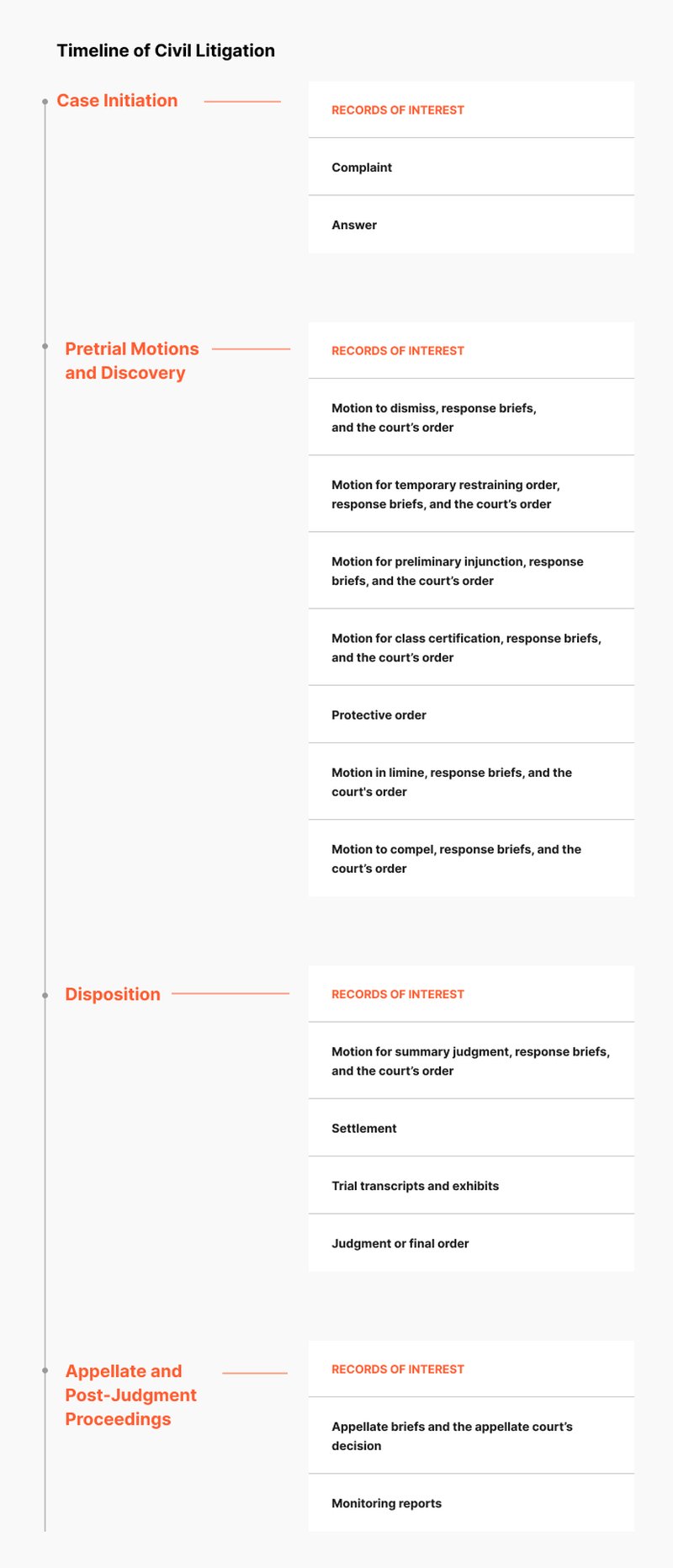
Terminology and Examples: Civil Litigation
-
Legal Terms
Appeal: A request to have a higher court review the decision of a lower court. Generally, courts of appeal can only hear a case when there is a final judgment or order resolving a case at the trial level. A notice of appeal will be filed in the lower court, but records related to the appeal, like the briefs, will be on a different docket and have a different case number with the higher court.
Discovery: The pretrial phase in which parties gather information from each other and from third parties. Discovery tools include document requests, depositions, interrogatories, and subpoenas. It is typically the longest phase of civil litigation and a significant source of disputes—parties frequently fight over what must be produced, which can reveal what evidence each side believes is most damaging.
Disposition: The final resolution of a case by the court, whether through settlement, dismissal, summary judgment, verdict, or other judgment. The disposition determines whether the case is over at the trial level and often triggers the deadline to file an appeal.
Injunction: A court order compelling a party to do or stop doing an action that violates the law. An injunction may be preliminary (time-limited until a final decision is made) or permanent.
Post-judgment proceedings: Legal actions that take place after a court enters final judgment. These include motions filed in the trial court to alter, amend, or vacate the judgment, or for a new trial based on newly discovered evidence or other grounds; appellate review, in which a party files a notice of appeal and the case proceeds on a separate docket in a higher court that may affirm, reverse, or remand, with further discretionary review sometimes available; and efforts to enforce or collect on a judgment, such as garnishment, liens, or contempt proceedings. These filings can reveal whether a judgment survived review and whether ordered relief was actually delivered.
Trial: The proceeding in which the parties present evidence and argument to a judge (bench trial) or judge and jury (jury trial), who then decide the disputed facts and apply the law to reach a verdict. The vast majority of civil cases settle or are dismissed before reaching trial, so trials are relatively rare, but when they do happen they generate valuable records: sworn testimony subject to cross-examination and exhibits admitted into evidence.
Documents and Records
Answer: An opposing party's response to the legal claims brought against them as outlined in the complaint. Answers often dispute factual allegations and raise defenses to liability, such as qualified immunity. An answer and a motion to dismiss are often filed together and serve the same general purpose of denying the lawsuit's validity.
- See here for an example of an answer.
Appellate brief: The written argument submitted by each party to an appeals court explaining why the lower court's decision should be affirmed or reversed. The appellant files an opening brief, the appellee responds, and the appellant may file a reply.
- See here for an example of an appellate brief.
Complaint: The document that officially initiates a lawsuit. A complaint includes an overview of the facts, an explanation of the legal claims being brought, and the specific remedy the plaintiff is requesting from the court. A complaint contains allegations, not proven facts. Plaintiffs can amend their complaints a limited number of times to add additional facts or fix certain problems. The complaint with the highest ordinal number will be the most complete and updated version.
- See here for an example of a complaint.
Monitoring report: A report prepared by a subject-matter expert or court-appointed monitor (common in prison and jail conditions cases) based on a review of documents and interviews with people who have been harmed. These reports often contain detailed findings, references to evidence, and assessments of whether conditions meet legal standards. They often surface information that does not appear elsewhere on the public docket and are worth obtaining whenever they exist.
- See here for an example of a monitoring report.
Motion for class certification: A formal request for the court to allow one or more individuals to proceed as representatives for a group of similarly situated people (a "class"). There are multiple requirements that must be met in order for a court to certify a class. Generally, a class may be certified when members of the group have been harmed in the same way for the same reasons. These motions are often accompanied by exhibits that help demonstrate that a problem is widespread and impacts a large number of people. Those exhibits may include declarations from individuals explaining how they have been harmed.
- See here for an example of a motion for class certification.
Motion for preliminary injunction or temporary restraining order: A formal request to the court to order interim relief before a decision is made on the merits of the legal claim. Courts may enter temporary restraining orders or preliminary injunctions if they believe the moving party has shown that someone will be "irreparably harmed" if the court does not take immediate action.
- See here for an example of a motion for preliminary injunction.
Motion for summary judgment: A formal request for the court to decide a legal issue without a trial. Summary judgment is allowable when the relevant facts are not in dispute and the judge only has to decide how to apply the law to the facts. These motions provide the most comprehensive pretrial overview of each side's arguments and are likely to include some of the best evidence in the case. Because so few lawsuits go to trial, the filings surrounding summary judgment are particularly important.
- See here for an example of a motion for summary judgment.
Motion in limine: A motion shortly before trial asking the court to exclude certain evidence from trial or limit its use. Evidence that was properly disclosed during discovery may nonetheless be inadmissible at trial or subject to restrictions. These determinations are made after written briefs and oral argument by both parties. Evidentiary hearings on these motions may be sealed or entered into the record on a delayed basis to prevent tainting potential witnesses or the jury pool.
- See here for an example of a motion in limine.
Motion to compel: A formal request asking the court to order a party to produce documents or make witnesses available that they have refused to provide during discovery. Motions to compel are worth tracking because a party's resistance to producing certain materials often signals that those materials contain significant evidence; otherwise there would be little reason to fight over them.
- See here for an example of a motion to compel.
Motion to dismiss: A formal request to have a court dismiss a case soon after a case has been initiated. These motions focus on procedural errors relating to how, when, or who filed the lawsuit. A case might be dismissed, for example, if a plaintiff has not presented enough facts to support a legal claim or if the time to file a lawsuit has run out.
- See here for an example of a motion to dismiss.
Protective order: A court order protecting the confidentiality of certain information. These can be stipulated to by both parties or the party seeking secrecy can unilaterally move for the judge to approve the order. These orders should also contain a factually specific explanation of the compelling interest that justifies the protection, but usually—and improperly—just provide vague generalizations.
- See here for an example of a protective order.
Settlement: An agreement between the parties that resolves a lawsuit before a final judgment is reached. Most civil cases end in settlement rather than trial. Settlement terms may be filed on the public docket, but they are frequently kept confidential, particularly when a government entity or institution is paying money to resolve claims of wrongdoing. When a settlement requires ongoing court supervision (a "consent decree"), it will include detailed obligations the defendant must meet, and compliance reports may be filed on the docket for years afterward. Settlement agreements are worth seeking out because they often reveal the value the parties placed on the claims and may include commitments to change policies or practices that do not appear in any other filing.
- See here for an example of a notice of settlement and settlement agreement.
Trial transcript and exhibits: The official written record of what was said in court and the evidence formally introduced by the parties. Transcripts are prepared by court reporters and capture witness testimony, attorney arguments, and rulings made from the bench. Exhibits include the documents, photographs, recordings, and other materials each side used to prove its case. Because the vast majority of civil lawsuits resolve before trial, these records are rare, but when they exist, they are among the richest sources of information in a case, containing sworn testimony subject to cross-examination and evidence that has been vetted for admissibility.
- See here for an example of a trial transcript and exhibits.
Criminal Prosecution
Journalists covering crime and the criminal legal system will almost certainly cover criminal prosecution of one form or another, whether it’s a murder trial or a feature on a local district attorney’s misdemeanor charging practices.
Background
Criminal lawsuits are brought by the government (represented by a prosecutor) against an individual accused of violating a law. Because most crimes are defined by state law, the majority of criminal prosecutions occur in state, not federal, court. Common state crimes include those related to harm to people (e.g. rape, assault) or property (e.g. theft, fraud). Common federal crimes include those related to drugs, human trafficking, firearms, and immigration.
States usually have separate criminal courts in their lower court systems, but federal district courts hear both criminal and civil cases. This impacts the types of cases that one will find in a given courtroom or on a judge’s schedule. If you are observing federal criminal proceedings, you may want to check the individual judge’s web page to see when they hear criminal matters. For example, this federal judge hears criminal proceedings on Thursday afternoons, and holds criminal and civil trials on weekday mornings.
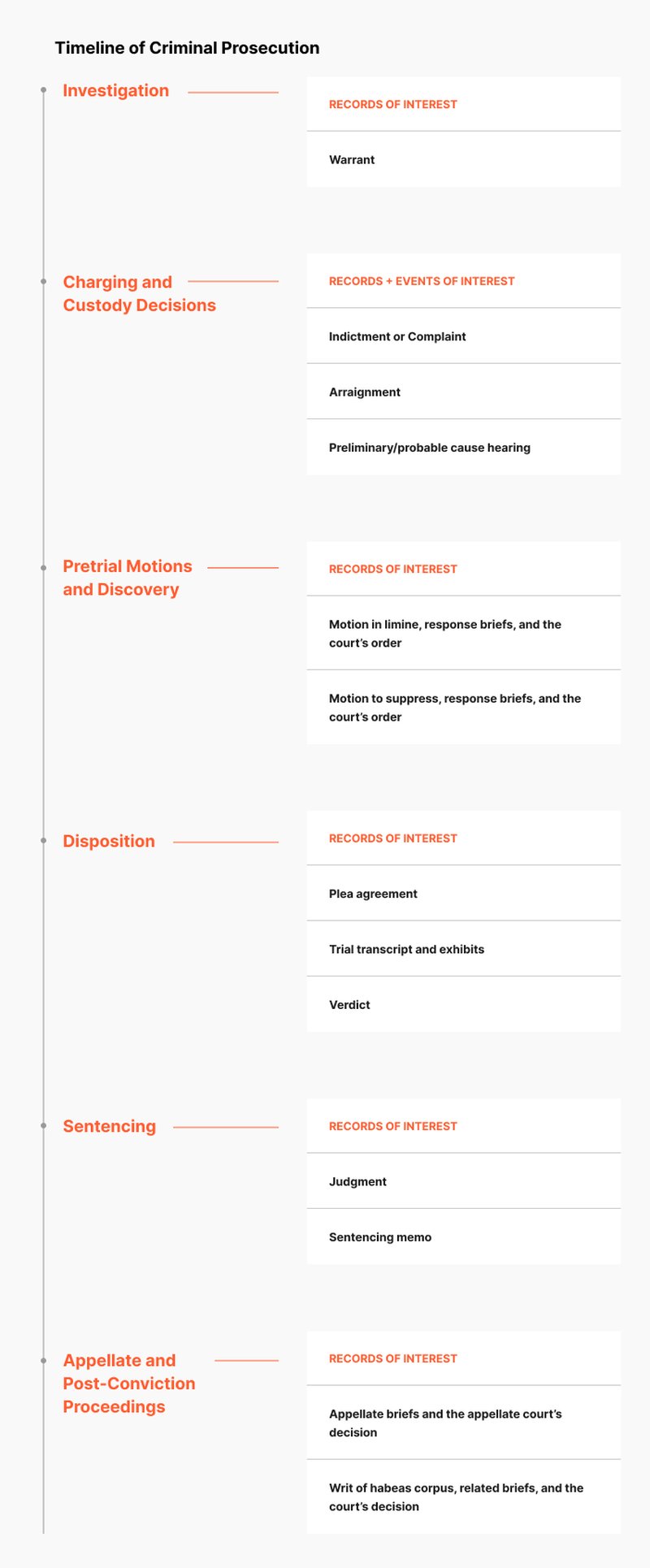
Terminology and Examples: Criminal Prosecution
-
Legal Terms
Appeal: A legal proceeding in which a party asks a higher court to review the decisions of a lower court. Criminal defendants have a right to one direct appeal of a conviction. If that appeal is denied, the conviction is finalized.
Arraignment: A court proceeding in which a person accused of a crime is formally informed of the charges against them and asked to enter a plea of guilty or not guilty. Bail is usually set at the arraignment.
Bail: Money or other security provided to a court in exchange for a defendant's release from custody before trial. Bail is intended to ensure the defendant's appearance at future court proceedings. The amount is typically set at the arraignment but may be revisited at subsequent hearings.
Charging: The decision by a prosecutor to formally accuse a person of a crime and the selection of which offenses to allege. Charging decisions are largely discretionary and generally unreviewable by courts. Prosecutors decide whether to bring charges at all, what level of offense to charge (felony vs. misdemeanor), and how many counts to file. These choices shape the defendant's exposure at sentencing and their leverage in plea negotiations. Charges may be brought by complaint or by indictment (see definitions below), and may be amended, added, or dismissed as a case proceeds.
Conviction: A formal judgment of guilt against a criminal defendant, reached either through a guilty plea or a finding of guilt following trial.
Discovery: The phase of criminal proceedings in which the prosecution is required to share evidence with the defense. What needs to be turned over is regulated by local rule, statute, and state and federal constitutions. This is typically the longest phase of a case and a significant source of constitutional violations. Under the United States Constitution, all exculpatory evidence in the government's possession, including information suggesting that witnesses or investigators may be biased or untrustworthy, must be turned over before trial. Despite this obligation, defense attorneys often must fight to obtain relevant materials, including disciplinary records of law enforcement officers involved in the case, which are only turned over in very rare instances. When the discoverability of specific materials is disputed, a judge may conduct an "in camera review," examining the contested materials privately to determine whether the defense is entitled to access them.
Disposition: The final resolution of a criminal charge or case through dismissal, a guilty plea, acquittal, conviction at trial, or diversion. Each charge has its own disposition, so a case may resolve with some counts dismissed and others resulting in conviction. Court records typically list the disposition and its date, which is what determines whether a case is closed and when appeal deadlines begin to run.
Grand jury: A closed proceeding in which prosecutors present evidence to a panel of citizens in order to have them vote on whether there is probable cause to issue an indictment.
Investigation: The process by which evidence about a suspected crime is gathered, before and sometimes after charges are filed. Law enforcement investigation may include interviews, surveillance, forensic testing, searches conducted with or without a warrant, and grand jury subpoenas. Defense teams investigate as well—often with far fewer resources and no subpoena power before charges are filed—interviewing witnesses the police did not, revisiting scenes, consulting their own experts, and developing mitigation evidence for sentencing. Defense investigation can uncover facts that never appear at trial, and its absence is frequently the basis of ineffective-assistance claims. Most of this work on both sides occurs outside public view, and records generated during an investigation—police reports, body-worn camera footage, informant agreements, officer disciplinary histories—often surface only through discovery, if at all.
Post-conviction proceedings: Legal processes available to a person after conviction to challenge the validity of their conviction, sentence, or continued imprisonment. These include direct appeals, habeas corpus petitions, and other forms of collateral review.
Preliminary/probable cause hearing: A court proceeding at which a judge determines whether there is sufficient evidence—specifically, probable cause—to require the defendant to stand trial. The defendant has the right to be present and represented by counsel at this hearing. As its name suggests, it is one of the first in-court proceedings in a case.
Probable cause: The legal standard required before law enforcement may arrest a person or obtain a warrant and before a prosecutor may require a defendant to stand trial. Probable cause exists when the facts and circumstances would lead a reasonable person to believe that something is probably true. It is a higher standard than reasonable suspicion but a lower standard than the preponderance of evidence required in civil cases and some criminal matters.
Sentencing: The legal process in which punishment is imposed by a court upon a defendant following conviction. Sentencing may occur immediately after a verdict or plea or after a separate sentencing hearing at which both parties may present evidence and argument. The judge imposes the sentence; in some jurisdictions, the jury plays a role in certain cases.
Trial: A formal court proceeding at which the prosecution presents evidence, and the defense may present evidence, before a judge or jury to determine whether the government can prove a defendant guilty beyond a reasonable doubt. A trial is held when a defendant pleads not guilty. Defendants may choose between a jury trial and a bench trial. In a bench trial, the judge serves as the finder of fact.
Documents and Records
Appellate brief: The written argument filed with an appellate court identifying alleged errors in the lower court proceedings and explaining why the conviction or sentence should be affirmed, reversed, or modified. The appellant files an opening brief, the government responds, and the appellant may reply. The government can also appeal dispositive decisions like motions to dismiss or suppress evidence. They can also appeal sentencing issues like a sentence they deem unduly light or to be based on a mischaracterization of evidence or a faulty interpretation of law. Appellate briefs cite the trial record and legal authority, and because they must summarize what happened below, they are often the most efficient way to understand the factual and procedural history of a case.
- See here for examples of an appellate brief and appellate court opinion.
Complaint: A charging document based on the attestation of a law enforcement agent and signed by a judge. With only a complaint, the government may proceed on a misdemeanor charge or, if it wants to pursue a felony charge, have the case indicted within a specified time frame.
- See here for examples of a complaint and a complaint sealing order.
Indictment: The formal charging document that initiates a felony criminal prosecution. It contains the charges and often the factual allegations a grand jury found supported by probable cause. Once the charging document is filed with a court, the prosecution officially begins and all constitutional rights held by the defendant attach.
- See here for an example of an indictment.
Judgment: The court's formal written order recording the conviction and the sentence imposed. It identifies the counts of conviction, the term of imprisonment or other punishment, any fines, restitution, or supervision conditions, and any counts dismissed. Entry of judgment ordinarily starts the clock for filing a notice of appeal.
- See here for an example of a judgment.
Motion in limine: A motion shortly before trial asking the court to exclude certain evidence from trial or limit its use. Evidence that was properly disclosed during discovery may nonetheless be inadmissible at trial or subject to restrictions. These determinations are made after written briefs and oral argument by both parties. Evidentiary hearings on these motions may be sealed or entered into the record on a delayed basis to prevent tainting potential witnesses or the jury pool.
- See here for an example of a motion in limine.
Motion to seal: A request asking the court to keep some or all of a document, proceeding, or docket from public view. Because criminal proceedings carry a strong presumption of public access, a motion to seal is supposed to identify a compelling interest, such as an ongoing investigation, witness safety, or the privacy of a minor, and to be narrowly tailored, with sealing lifted once the justification expires. In practice, motions to seal are frequently granted on generalized assertions and sealed materials often remain sealed long after the stated need has passed.
- See here for an example of a motion to seal.
Motion to suppress: A motion made to argue that evidence that the government intends to use was obtained unconstitutionally, typically in violation of the Fourth, Fifth, or Sixth Amendment.
- See here for an example of a motion to suppress.
Plea agreement: An agreement between a defendant and a prosecutor in which the defendant pleads guilty in exchange for a concession from the prosecution—such as reduced charges, dismissal of certain charges, or a recommendation to the judge for a more lenient sentence. The vast majority of criminal cases in the United States are resolved through plea bargains rather than trial.
- See here for an example of a plea agreement.
Protective order: A court order restricting how material disclosed in a case may be used or shared, most commonly governing discovery produced by the prosecution to the defense. Protective orders may bar the defense from copying or disseminating certain materials, or limit who may review them. Unlike sealing orders, which restrict public access to court filings, protective orders restrict what the parties themselves may do with information they possess.
- See here for an example of a protective order.
Sentencing memo: A written submission filed before a sentencing hearing in which a party argues for a particular punishment. Prosecution memos emphasize the seriousness of the offense and the defendant's history; defense memos typically present mitigating evidence about the person's background, circumstances, and prospects, often with attached letters of support and expert evaluations.
- See here for examples of a prosecution's sentencing memo, a defendant's sentencing memo, and the minutes of a sentencing hearing.
Trial transcript and exhibits: Records of testimony and physical evidence presented at trial. There is a strong legal presumption that everything presented to a jury—testimony, documents, photographs, and other exhibits—should be available to the public. It is rare for exhibits to be filed under seal or for testimony to be taken in a closed courtroom. When sealing does occur, it is typically to protect the privacy or safety of witnesses or victims, particularly minors. Sealed exhibits may be shown to the jury but not to members of the public in the gallery. Transcripts may contain redacted portions reflecting material that was sealed by prior agreement or that was the subject of admissibility arguments conducted outside the presence of the jury.
- See here for an example of a trial transcript and exhibits.
- Pages numbered 226-229 show that something occurred off the record, and pages numbered 282-284 show the process for publishing an exhibit to the jury and not the gallery.
Verdict: The finding by a jury (or by a judge in a bench trial) on whether the government has proven each charge beyond a reasonable doubt. A jury verdict in a criminal case must generally be unanimous. A verdict of not guilty is an acquittal and cannot be appealed by the government or retried. A jury may convict on some counts and acquit on others, or fail to reach agreement on any count, resulting in a mistrial.
- See here for an example of a verdict handed down by a jury.
Warrant: A written order issued by a judge authorizing law enforcement to conduct a search, seize property, or arrest a person. Warrants are issued upon a showing of probable cause. Search warrants and arrest warrants may be temporarily sealed to prevent the accused from receiving advance notice, but once an arrest has been made or charges have been formally filed in open court, the justification for sealing typically dissolves and the documents become public.
- See here for examples of an arrest warrant and a search and seizure warrant.
Writ of habeas corpus: A legal petition filed by an incarcerated person asking a court to determine whether their imprisonment is lawful. Criminal habeas corpus proceedings are a form of post-conviction relief separate from one's direct appeal, because it asks a court to consider matters that fall outside of the official record of the case. People in immigration detention also initiate habeas corpus proceedings to challenge the lawfulness of their detention.
- See here for examples of a petition for a writ of habeas corpus and an order granting a writ of habeas corpus.
Accessing the Records
Federal Courts
Federal court records are available through a service called PACER (Public Access to Court Electronic Records) provided by the Administrative Office of the U.S. Courts. You must have a PACER account to use the service, which you can create free of charge. PACER charges $0.10 per page, not to exceed $3.00 per record. PACER maintains a page with instructions on how to use the service as well as a “training site” that walks you through using the search functions and opening documents.
Dockets can be lengthy and span years or even decades, particularly in prison conditions cases. If you are interested in a case or filing that you find on PACER, it is worthwhile to search the docket number in some of the free databases listed below before paying the fee to download the full docket directly from PACER.
State Courts
There is no uniform system for accessing all state court records. Some states, like Alabama and Mississippi, have electronic systems that allow you to access case information and documents from counties across the state. Other states, like California and Georgia, have county-specific systems, and every county may not have an electronic system that allows remote access.
The fees for accessing electronic court records in state courts are often more expensive than federal courts. For example, in Los Angeles County Superior Court, the first five pages of a record cost $1 per page, with each additional page costing $0.40 not to exceed $40 per document.
Some courts require you to visit the local court house to inspect court records, either because they only keep paper records or because they only permit viewing of electronic records at a designated kiosk or computer. Photocopying fees almost always apply, and many courts prohibit taking pictures of documents. Some states, like Tennessee, only allow residents of the state to access court records.
Other Sources
Free court records may be available elsewhere, particularly for larger or more high-profile cases.
- CourtListener is a free legal research website containing millions of court records from both federal and state courts.
- The Civil Rights Litigation Clearinghouse collects and presents documents and information from large-scale civil rights cases across the United States.
- Just Security tracks litigation against the Trump administration including copies of some key documents, like complaints.
- Many public interest law firms, including the Center for Constitutional Rights and Public Justice, have databases that allow you to read more about their cases and access certain court records. On most organizations’ websites, case pages can be found under issue area headings, such as “Our Work” or “What We Do,” or linked in press releases.
Sealed Records
Occasionally, you may encounter records that are not publicly available.
The legal test for sealing a court record varies by jurisdiction but generally involves balancing the need for secrecy with the need for public access. Courts may consider a variety of factors in this analysis, including the strength of the privacy interest, the possibility that someone could be harmed if information is disclosed, whether someone has objected to the disclosure, and the purposes for which the documents were introduced during the proceedings. For example, the presumption of access is higher at trial when evidence is being presented to a judge or jury than at the discovery stage when the parties are fighting about whether information should be produced.
In civil cases involving police or jail/prison officials, commonly sealed records include:
- Disciplinary records
- Facility policies and procedures
- Staffing reports
- Audits and inspections
- Logs documenting compliance with particular policies
- Reports from subject-matter experts (such as doctors, mental health care providers, or former prison administrators) providing their opinion of whether the evidence constitutes a harm
- Post-judgment monitoring reports (often conducted by subject-matter experts)
- Video, including body-worn, handheld, or stationary
In criminal cases, commonly sealed records include:
- Information relating to children or confidential sources
- Ex parte requests (requests made by one party without the other party or the public being able to see the request; for example, a request to prevent someone from entering the courtroom during a proceeding)
- Law enforcement disciplinary records
- Information related to ongoing criminal investigations
Trying to unseal a sealed record can be difficult. In federal court, you will need to file a motion to intervene as a third party for the limited purpose of unsealing a document or challenging a confidentiality restriction. In state court, this procedure—moving to intervene—is likely similar to federal court, but you should contact the local court to seek specific guidance for what steps you must take.
In almost all instances, you should seek a lawyer to help you through this process, as challenging the sealing of a document requires presentation of legal arguments. Your argument for why a record should be unsealed will likely focus on 1) why it is important for the public to have access to this document and 2) why the possible harm that would come from disclosing the record is either speculative or has diminished over time.
See below for examples of:
- A motion to intervene for the limited purpose of unsealing
- A motion to unseal documents
- The same record in sealed and unsealed form
Public Records
Author: Ian Head, Center for Constitutional Rights
Table of Contents
- Introduction
- What to Request
- Structuring a Public Records Request
- Reviewing Public Records
- Appealing a Rejection
- Other Resources
Introduction
When information about the criminal legal system isn’t publicly available, journalists can submit a public records request to obtain that information. While these requests are often time-consuming, they can yield crucial insights into the operations and decision-making within criminal legal system agencies across the country. This section of the toolkit provides step-by-step instructions on how to file a public records request, along with examples of information that is particularly relevant for journalists covering the criminal legal system.
Federal Freedom of Information Act (FOIA)
Requests to any federal agency are governed by FOIA (5 USC 552). Each major agency has its own regulations for processing requests. All federal agencies are governed by the same nine FOIA exemptions (listed at 5 USC 552(b)), including exemption (b)(7) specific to law enforcement agencies, (b)(1) for national security issues, and (b)(3) for records exempted by other federal statutes. However, you may have the ability to argue for less restrictive interpretations of these exemptions depending on the federal or appellate court in which you file your request.
Some parts of the federal government don't respond to FOIA requests: all of Congress, most of the Office of the President, and nearly all federal courts. However, communications between these offices and agencies that do respond to FOIA are potentially releasable by those agencies.
State Open Records Laws
Each state is governed by its own open records law. While many of these laws are patterned after the Freedom of Information Act, they each have unique requirements. The Reporters Committee for Freedom of the Press maintains a compendium of state open records laws. Below is a list of important features of these laws:
- In some states, you can request records from legislative and judicial bodies as well as non-governmental agencies and private actors that have contracts with the government.
- Law enforcement exemptions are less restrictive in some state open records laws than they are in FOIA. For instance, in Florida, law enforcement investigatory records are typically only exempt if an investigation is “active.” However, some states, like Minnesota, have other laws on the books that allow law enforcement agencies to refuse records requests. Finally, many exemptions in state laws are discretionary (not mandatory), so it can be useful to remind agencies that there is nothing legally stopping them from releasing information.
- Some states, such as Alabama and Tennessee, only allow for residents of those states to file public records requests.
- States have different timelines for when agencies must respond and how long you have to file an administrative appeal if your request is denied. Pay attention to these time frames so that you don’t have to restart your request.
What to Request
Emails, text messages, and other communications
Tips:
- If you expect a lot of emails, you can ask agencies to first produce emails without attachments so that you can identify the attachments you’d like them to produce.
- If possible, narrow your request to particular dates or types of communications to avoid delays caused by agency officials combing through thousands of emails.
- Names and email addresses of government employees may be redacted. It can be worth arguing that any public-facing officials—usually those in leadership—shouldn’t be redacted since they are well-known. Even if full email addresses are kept private, you can ask for the domain names of all email addresses copied on various communications, since that can often provide clues of who an agency might be talking with outside of its own members.
Examples:
- This request for communications related to the deportation of Cameroonians led to the release of emails from an ICE official asking for help responding to a reporter’s inquiry about torture at a detention center.
Policies, memos, directives, and other documents related to official agency orders
Tips:
- Ask agencies not to produce already public documents. This is important as some of these documents—such as a 500-page copy of a federal regulation that is already publicly available—can delay you getting more important documents.
- It can be useful to cite an agency official discussing the policy with a news outlet in your request, particularly if the existence or details of the policy are in dispute (e.g. former NYC Mayor Eric Adams and police officials acknowledging the NYPD’s gang database along with some specifics on the type of information it contains to the New York Post).
Examples:
- This request targets the policies regarding the use of automated license plate readers in Eugene, OR. Policies of interest include when an alert can justify a stop, the requirements for independent verification before taking enforcement action, the procedures for handling false positives, and audit and error rate monitoring requirements.
- This request for information on fees paid by incarcerated people in Maine names a list of specific policies of interest: per diem fees, ability to pay determinations, penalties for late or non-payment, etc.
Training materials, like PowerPoint presentations and course outlines
Tips:
- These materials can slow down a records request because they are full of already publicly available and/or outdated information. If you request them, ask for the most recent or currently in use versions. You can also ask an agency how large these sets of records are before having them produced.
- If possible, cite a document that proves the existence of the materials.
Examples:
- This request for materials used to train Prison Rape Elimination Act inspectors cites a specific page of a published audit of a New York correctional facility that lists nine specific training records by name.
- This request led to the release of a PowerPoint presentation used to train members of Homeland Security Investigations on firearms safety and basic marksmanship.
Data and records
Tips:
- Cite to specific, known databases in your request, rather than assuming the agency will search multiple databases looking for the information you’ve requested.
- Because many open records laws state that government agencies don’t need to “create” new records or data in response to a records request, attempt to find previously published data that you can refer to when making your request. You can also look for blank or redacted forms or internal policies that list the types of data agencies collect.
- Court records from FOIA litigation may contain information about the types of data and databases maintained by government agencies. See the section above for more information about obtaining court records.
- The Trace and MuckRock published a guide to requesting police data after making dozens of their own requests. They recommend asking agencies for data dictionaries, record layouts, and user guides describing how their databases work.
Examples:
- This request names a specific, publicly known database (Virginia’s Criminal Justice Agency Directory lookup) rather than describing what it wants in general terms.
- This request for Florida police use of force data includes the names of specific fields the requester is interested in and offers steps the agency can take if some of the fields are not available along with alternative formats the information can take if spreadsheets are not a possibility.
- This request for West Virginia prison staffing information names the data points of interest along with the relevant units of analysis (per prison, per month, etc.).
- This request for overtime pay records from the Evanston Police Department specifies the exact fields of interest for each payment—name or badge number, rank, dates, hours, rate, and total paid—and separately asks for any summary reports or spreadsheets the department has already prepared, a nod to the rule that agencies don't have to create new records, only produce existing ones. It also asks for the reason or assignment code attached to each overtime entry "to the extent such records exist" (those codes reveal whether overtime is driven by special events, court appearances, or chronic understaffing).
- This request to the Kentucky State Police forensic lab seeks the lab's own quality assurance paper trail (every accredited crime lab is required to document its own errors). The request defines its own terms ("for purposes of this request, non-conformance reports include...") so the agency can't claim confusion over nomenclature, and tells the agency exactly where to look by naming the Quality Assurance and Accreditation units that typically maintain these records.
Video and audio recordings from body-worn cameras and stationary cameras (e.g. precinct, surveillance, and dashboard cameras)
Tips:
- Most cameras collect a variety of metadata as well. For example, Axon body-worn cameras capture data such as geolocation, date, time, who has viewed (or edited) a video, and even tags and notes that officers can add to their videos.
- If an incident involves multiple police agencies (e.g. a pursuit, a joint operation, a scene with overlapping jurisdictions), request footage from each agency so that you have as much information as possible.
- The Better Government Association published a guide to requesting body camera footage in Illinois. While many of its recommendations are Illinois-specific, it has broadly applicable information on how to frame the key parts of a similar request in other states.
Examples:
- Boiler-plate language: “Pursuant to (insert relevant law here), I am requesting access to copies of the following records: Body cam footage from all law enforcement officers present for the arrest of ‘FIRST AND LAST NAME’ on ‘DATE’ at ‘LOCATION’ (if known).”
Surveillance summaries and reports from social media monitoring
Tips:
- Agencies may compile reports, such as “threat assessments,” that contain a mix of data scraped from the internet and social media along with information collected via surveillance, including undercover operations and/or technology.
- Getting information on the identities of undercover agents, informants and others through public records requests is nearly impossible, but it may be possible to get records related to how such units operate, policies guiding the legality of their operations, or training materials.
- This request led to the release of emails discussing FBI surveillance of people participating in Black Lives Matter protests.
- This request regarding the Milwaukee Police Department’s use of social media surveillance technologies names eight specific vendors by name rather than describing the technology generically, asks for the full procurement record alongside training materials and use policies, and requests all records about sharing surveillance data with outside agencies, which is often where the most significant civil liberties implications are buried. It also covers software that "has been used" rather than only current tools, capturing discontinued programs the agency might otherwise omit.
Contracts, memoranda of understanding/agreement, and other records related to formal arrangements between government agencies and private companies (or intergovernmental agreements)
Tips:
- Gaining access to records held by private contractors can be difficult, depending on the laws of the state in which you’re working. At the federal level, records related to private contractors can be requested, but the federal agency will generally have to allow the private entity the ability to review and redact material before sending it back to the requester.
- When requesting contracts with surveillance technology vendors, the contract itself is rarely the most revealing document. By asking for how the contract was awarded alongside what it contains, the request makes it possible to examine whether the selection process was competitive, what the agency prioritized, and what the technology actually costs.
Examples:
- This request asks for the complete procurement record: the original invitation to bid, all vendor responses, the evaluation scorecards used to select the winning bidder, the current contract, all amendments, and all invoices. The request also cites CBP's own press release and a Washington Post story to establish that the records exist and includes a date range anchored to a specific public event.
- This request asks ICE for records related to the contracts, statements of work, and training documents associated with the companies Paragon and Cellebrite, which have made national news for their surveillance software.
- This request targets four essential records in a single filing: the internal policies governing ALPR use, all vendor contracts with named companies (Flock, Vigilant, Axon), a physical map of every camera the agency owns, operates, or can access, and all data sharing agreements describing how plate reader data is retained and transferred to outside agencies.
Structuring a Public Records Request
Identify and date your public records request. State that you are making a public records request, and cite the applicable public records law. Add the date you send your request somewhere clearly visible, such as the top of the request.
- “I am making this request for public records pursuant to New York Public Officers Law §§ 84-90.”
- “I am making this request pursuant to the Freedom of Information Act, 5 USC 552(a).”
State the agency or agencies to which you are directing the request. If possible, name any offices or sub-components of those agencies you believe have information relevant to your request.
- “Please direct this request to the Georgia Information Sharing Analysis Center and any other applicable components and offices with the Georgia Bureau of Investigation (“GBI”).”
- “This is a request to the U.S. Immigration and Customs Enforcement Agency (“ICE”), the U.S. Department of Homeland Security (“DHS”), the U.S. Department of Justice Executive Office for Immigration Review (“EOIR”), and the U.S. Department of State (“DOS”)…We ask that you please direct this request to all appropriate offices, field offices, and departments within each agency, including but not limited to the EOIR’s Board of Immigration Appeals (“BIA”), as well as ICE Air Operations (IAO) within the ICE Office of Enforcement and Removal Operations (ERO) and ICE’s New Orleans and Atlanta Field Offices.”
Give the agency a timeframe of the records you’re requesting. You can give different timeframes for different parts of your request if necessary.
- “Please search for records starting on January 20, 2025 through present.”
List the specific records you are requesting. Cite any public documents proving that the records you are requesting exist (or attach articles or other media as exhibits to your request). If relevant, you can suggest specific search terms that agency officials can use to locate the records.
- "All current policies and procedures regarding medical copays and room & board costs or fees for which inmates are or may become liable. Please include all policies and procedures related to how fees are set, accrued, imposed, collected, and enforced (such as those related to per diem fees, ability to pay determinations, penalties for late or non-payment, authorization for civil or criminal action for payment enforcement, etc.)."
- "Emails with the term “Operation Palladium” using its full name or any acronym or abbreviation, including “Palladium,” between DHS or ICE and the New York Police Department (“NYPD”) between the dates of 12/01/2019-3/31/2020."
Specify how you would like to receive the records. PDF is the format requested by many FOIA lawyers. When requesting data, you can also ask for it to come in its “original form” (such as Excel spreadsheets). When requesting communications, you can ask that “parent-child” relationships between emails and their attachments be maintained, so that any email attachment is not produced separately from the email it was originally part of.
- Please search for responsive records regardless of format, medium, or physical characteristics, and including electronic records. Please provide the requested documents in the following format: Provided via email or on a CD, DVD, hard drive or other hardcopy media; In PDF format wherever possible; Electronically searchable wherever possible; Each paper record in a separately saved file; "Parent-child" relationships maintained, meaning that the Requester must be able to identify the attachments with emails; Any data records in native format (i.e. Excel spreadsheets in Excel); Emails should include BCC and any other hidden fields; With any other metadata preserved.
- “I would prefer the request filled electronically, by e-mail attachment if available or CD-ROM if not.”
Address fees and potential fee waiver. FOIA allows for the full waiver of processing fees associated with a request. State records laws usually leave fees up to the discretion of the agency, but it never hurts to ask. The key points to make when asking for a fee waiver are that you are doing this in the “public interest” and have no “commercial interest” in the records received. It also is useful to provide a brief summary of your credentials as a journalist—what outlets you’ve worked at, recently published articles, etc.
- “I also request that, if appropriate, fees be waived as we believe this request is in the public interest, as suggested but not stipulated by 1 M.R.S.A. § 408(6). The requested documents will be made available to the general public free of charge as part of the public information service at MuckRock.com, and is not made for commercial usage. In the event that there are fees, I would be grateful if you would inform me of the total charges in advance of fulfilling my request.”
- See Part F of this FOIA request for more detailed language on FOIA fee waivers.
Include a sentence or two on urgency. The FOIA allows you to ask for “expedited processing” which is supposed to generate a faster response, but these are rarely granted in practice. State laws do not usually have an “expedited processing” mechanism. However, you can build a written record of urgency in your request and subsequent communications with an agency, so that if you end up in court, you can show a judge that you have maintained that there is an urgent need for the records you seek since you filed your request.
- “Thank you in advance for your anticipated cooperation in this matter. I look forward to receiving your response to this request within 5 business days, as the statute requires.”
- See Part E of this FOIA request for more detailed language on expedited processing.
Specify the address to which responses should be sent. Be clear about where you want to receive any responses from the agency to which you send your request. This helps ensure that you don’t miss a response or deadline which could allow the agency to close your request or prevent future litigation.
Remind the agency of its requirements under state or federal law. Include language restating the law on “segregating” non-exempt material and response deadlines.
- “Thank you in advance for your anticipated cooperation in this matter. I look forward to receiving your response to this request within 5 business days, as the statute requires.”
- “Where exemptions to the Public Records Act are discretionary, we ask you not to withhold such records, even if they might qualify for withholding under the law. If you withhold any records as exempt, please redact the exempted portions and release all segregable portions of the records as required by the Public Records Act. Miss. Code Ann. § 25-61-5(2). Note that any redactions require an explanation in writing with reference to the specific statutory exemption(s) upon which you rely. We look forward to your reply as soon as is practicable, and no more than seven working days from your receipt of this request. See Miss. Code Ann. § 25-61-5(1)(a).”
Sign the request. To be safe, sign your request so that you can certify it came from you. Some states and federal agencies require this.
Reviewing Public Records
Maintain a log of what you requested, when you sent it, the legal deadline for a response, and what you received. This protects you if you need to appeal a denial or go to court to enforce a request.
Create a system for indexing the documents. The Center for Constitutional Rights offers a downloadable spreadsheet that can be used for this purpose.
Decide what your priorities are. If you receive a lot of records, there will likely be junk or irrelevant information. Especially if you are doing your document review with a team, have a short list of priority items on which the team should focus.
After you finish a review session, write up a short summary of what you reviewed so that you have something to refer back to later or share with others on your team.
Look for leads that might help with future records requests or investigations. Pay attention to the date(s) on the documents. Do they correspond to what you asked for, do they seem like the most recent version, does it seem like anything is missing, etc.
Look for over-redaction. If you get an email but the entire body is redacted, this is potentially a place to appeal or follow up with the agency about segregating out factual or other information.
Identify missing documents. Does it seem like a memorandum ends half-way through? Does an email list lots of attachments but you only seem to have gotten one?
Appealing a Rejection
Many open records laws, including FOIA, have an administrative appeal process: you can administratively appeal denials, partial productions, fee disputes, and in many cases unreasonable delays. The window for appeal depends on the jurisdiction. Below is a list of recommendations for filing a successful appeal.
Appeal letters should specifically identify which exemptions you're challenging and why, with cites to any relevant case law if possible.
At the federal level, you can always appeal to the agency's FOIA appeals office and ultimately to federal court.
At the state level, many attorneys general offices handle FOIA complaints, and some states have a dedicated ombudsman or sunshine law enforcement body.
A denial isn’t necessarily final. Agencies can produce records on appeal that were initially withheld without going into any kind of litigation. And if a state does not have a specific appeal mechanism, that doesn’t stop you from contacting the agency and finding ways to narrow or shape your request so that the agency can respond in some way.
For a successful example, see this reporter’s appeal pushing back on the investigatory exemption claim from the Cambridge Police by pointing out that dozens of other departments—including Boston Police and NYPD—have released identical materials without any harm to their law enforcement function and that use of force policies govern how officers interact with the public, not confidential investigative techniques. The department ultimately reversed course and gave the reporter the documents.
Other Resources
- MuckRock is an essential resource used by journalists as well as advocates, lawyers, and academics. The site makes it easy to file and track state records requests, and it is connected to DocumentCloud, which hosts tens of thousands of pages of records produced via public records requests.
- MuckRock’s guide to using FOIA for access to law enforcement records
- MuckRock’s guide to requesting police misconduct documents and data
- The Reporters Committee for Freedom of the Press' Open Government Guide for Journalists is a detailed guide for state records requests.
- The National Freedom of Information Coalition has a clearinghouse of research and tools, including sample request and appeal letters for all 50 states and federal agencies, a media law guide, audits of agency compliance, and tips on how to FOIA an agency's own FOIA logs to see what other requesters have been asking for.
- The Marshall Project’s investigative reporter Alysia Santo created a toolkit for making strategic and detailed public records requests for criminal legal stories, including how to map the agencies and documentation trails relevant to a given investigation.
- FOIA.wiki is a collaboratively maintained resource on federal FOIA law, produced by the Reporters Committee with contributions from MuckRock, the National Security Archive, and others.